
Who can see my requests?
Webhook URLs are write-only. Only people with the dashboard link can read what a URL caught, the inspector loads no third-party code, and everything is erased when the URL expires.
Webhooks often carry API keys, customer details and payment events. webhook.stream is designed on that assumption.
Only people with the dashboard link
Each URL has two addresses:
| Address | Looks like | Can |
|---|---|---|
| The webhook URL | https://in.webhook.stream/… |
Receive requests. Nothing else |
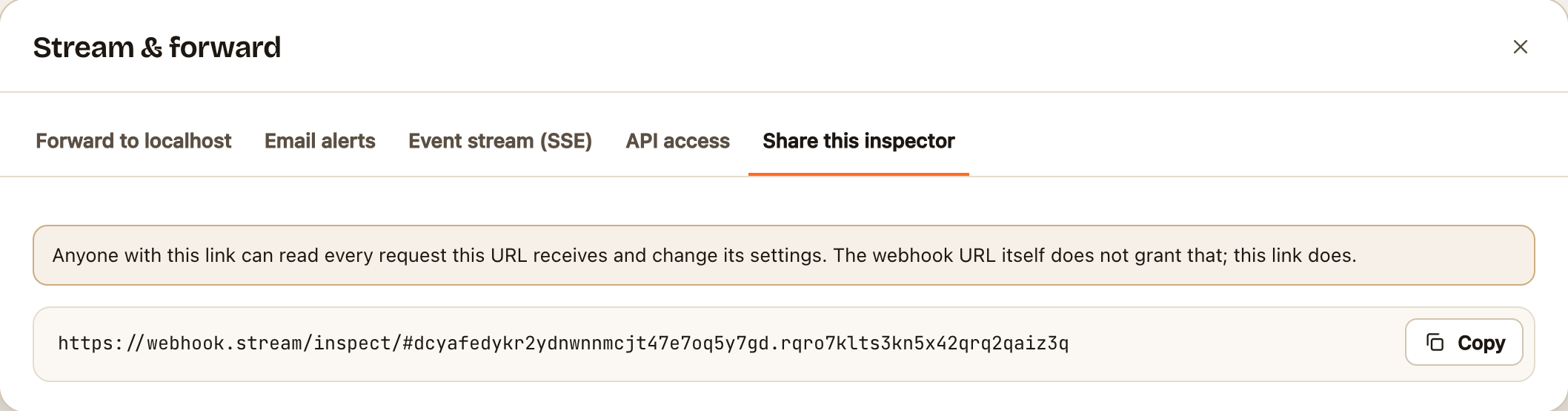
| The dashboard link | https://webhook.stream/inspect/#… |
Read every request, change the response and automations, and delete the URL |
So the webhook URL is safe to paste into a service's settings, and it doesn't matter if it turns up in their logs or a screenshot. Nobody can read your requests from it.
The dashboard link is what needs protecting. Its key sits after the #, which browsers never send to a server when the page loads. Your browser keeps it so you can come back, and it's only ever sent to webhook.stream in an Authorization header. Share the link only with people who should see the data. See Open your inspector on another device, or share it.
Nothing else runs next to your data
The inspector, where captured requests are shown, loads code from webhook.stream only. No analytics, no advertising, and no outside fonts or libraries. Ads and analytics appear only on content pages, such as the home page and guides, never in the inspector.
Your signing secrets stay in your browser
Signature checks run in your browser. The secret you paste is never sent to webhook.stream, never stored, and forgotten when you close the tab.
Everything is deleted on schedule
- At expiry, every captured request, response setting, automation and delivery log on the URL is erased. A free URL lives for at most 7 days.
- Earlier, if you like: ⋯ → Delete this URL erases it at once, and ⋯ → Clear requests empties it but keeps it running. See How long a URL lasts, and how to delete it.
- Staff don't read captured requests, except where it's necessary to investigate a specific abuse report or security incident.
- Captured requests are never sold, shared or used to train models.
Sensible habits
- Use services' test modes and test secrets wherever they exist.
- Avoid sending real customer data or live credentials to any testing tool, this one included.
- Delete a URL when you've finished with it.
- If a dashboard link reached someone it shouldn't have, delete the URL and make a new one.
For the full details, see the privacy policy and the security overview.