
In this section
Free limits and Pro passes
What a free webhook URL allows, what a Pro pass adds, and how passes work. A pass is a one-time payment that extends one URL. No account and no subscription.
Everything webhook.stream does is free, with limits that suit testing. When a URL turns into something you rely on, a Pro pass keeps that same URL alive for longer and raises its limits.
How a Pro pass works
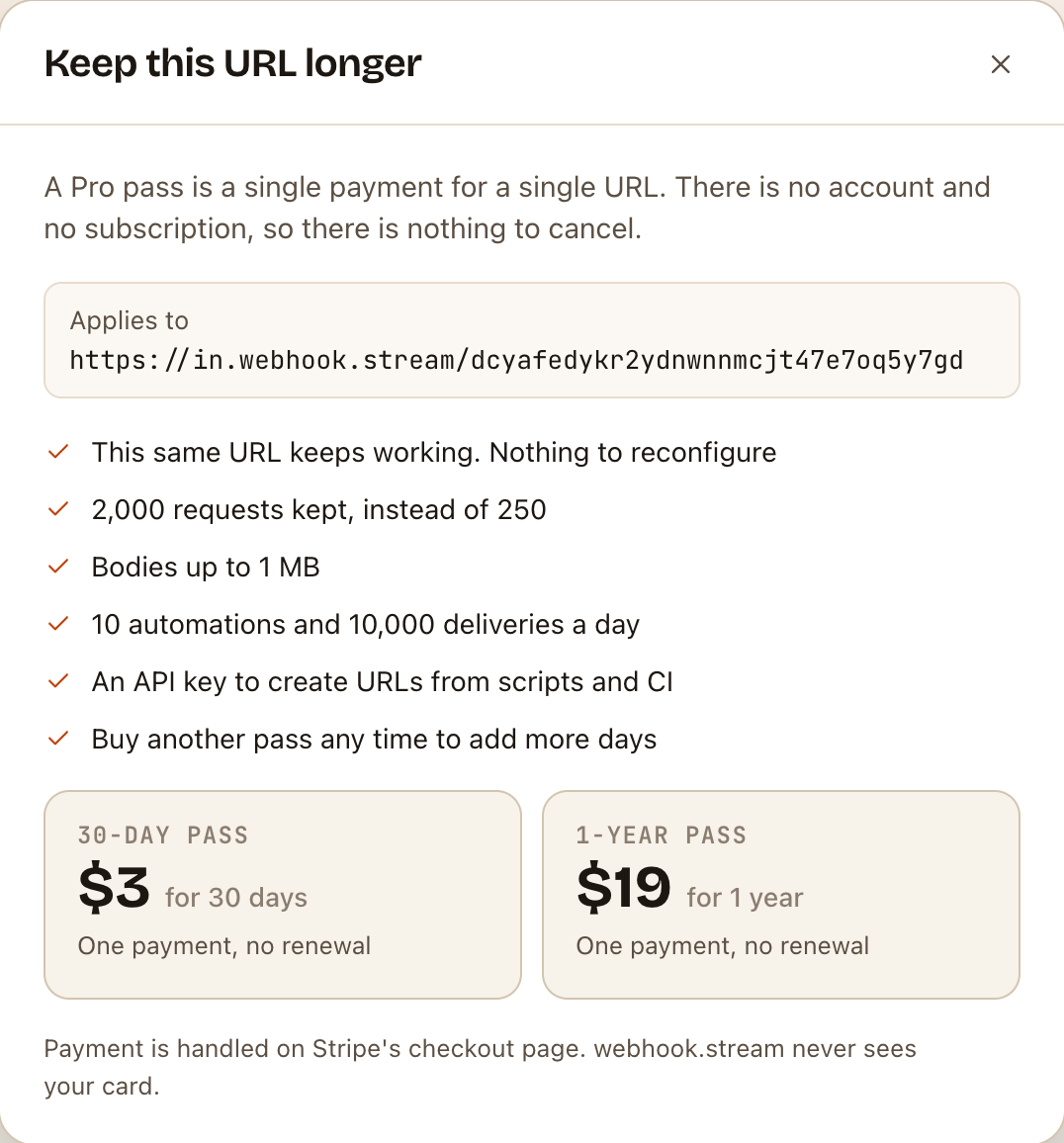
- It's a single payment for a single URL. There's no account and no subscription, so nothing renews and there's nothing to cancel.
- It adds time. A pass adds 30 days or 1 year to the URL's current time left. Buy another whenever you like and the days stack.
- The URL doesn't change. Everything already captured and set up stays, and nothing needs updating at the services that send to it.
- It belongs to the URL, not to a person. Anyone with the URL's dashboard link gets the benefit.
- When the pass runs out, the URL expires like any other, unless you extend it first.
For current prices, see the pricing page.
Free and Pro, side by side
| Free | With a Pro pass | |
|---|---|---|
| How long the URL lives | 1 hour to 7 days, chosen when it's made | +30 days or +1 year for each pass |
| Requests kept (oldest dropped first) | 250 | 2,000 |
| Requests over the URL's whole life | 25,000 | 1,000,000 |
| Body size stored | 512 KB | 1 MB |
| Automations | 3 | 10 |
| Automation deliveries | 30 a minute, 1,000 a day | 120 a minute, 10,000 a day |
| Live connections (inspector tabs, streams, forwarders) | 12 | 50 |
| Create URLs from scripts with an API key | No | Up to 200 a day |
| Inspector, signature checks, responses, stream, forwarding to localhost | Included | Included |
Limits that apply to everyone
| Limit | Value | When it's reached |
|---|---|---|
| Requests to one URL | 600 a minute | The sender gets 429 with Retry-After, and the request isn't recorded |
| New URLs from one network | 6 a minute, 30 a day | Creating a URL fails until the time passes |
| Automation delivery time | 8 seconds | The delivery is logged as failed |
| Response delay | 10 seconds at most |
A larger body is accepted and cut short, not refused. The request is recorded with its true size.
Why there are limits
So that one busy or misused URL can't slow things down for everyone else. They're enforced per URL, at the edge, before anything else runs.