
In this section
Test how a service handles failures and timeouts
Make your webhook URL answer with an error or answer slowly, then watch how the sending service retries, backs off or gives up, before your real server finds out the hard way.
Every service that sends webhooks retries when a delivery fails, but each does it differently: how often, for how long, and what it does when it gives up. You can watch that behaviour safely by making your test URL fail on purpose.
Before you start
- Use the service's test mode or a sandbox. Some services disable a webhook that keeps failing.
- Every attempt is recorded, including retries, even while the URL is answering with an error. That's what lets you see the pattern.
Simulate a server error
- Click Response in the toolbar.
- Under Start from, choose Simulate a failure. The status becomes
500. - Click Save response.
- Trigger one event in the service.
Each retry appears in the list as a new request. Compare their times to see the retry schedule. Open two of them and compare their headers: many services add an attempt number or a delivery ID that stays the same across retries.
Try other statuses too. A 410 Gone tells some services to stop sending, and a 429 Too Many Requests with a Retry-After header (add it under Extra headers) asks them to slow down.
Simulate a slow server
- Click Response.
- Set Delay (ms) to longer than the service's timeout, up to 10,000 (10 seconds). For example, Slack waits 3 seconds and Shopify 5.
- Click Save response and trigger an event.
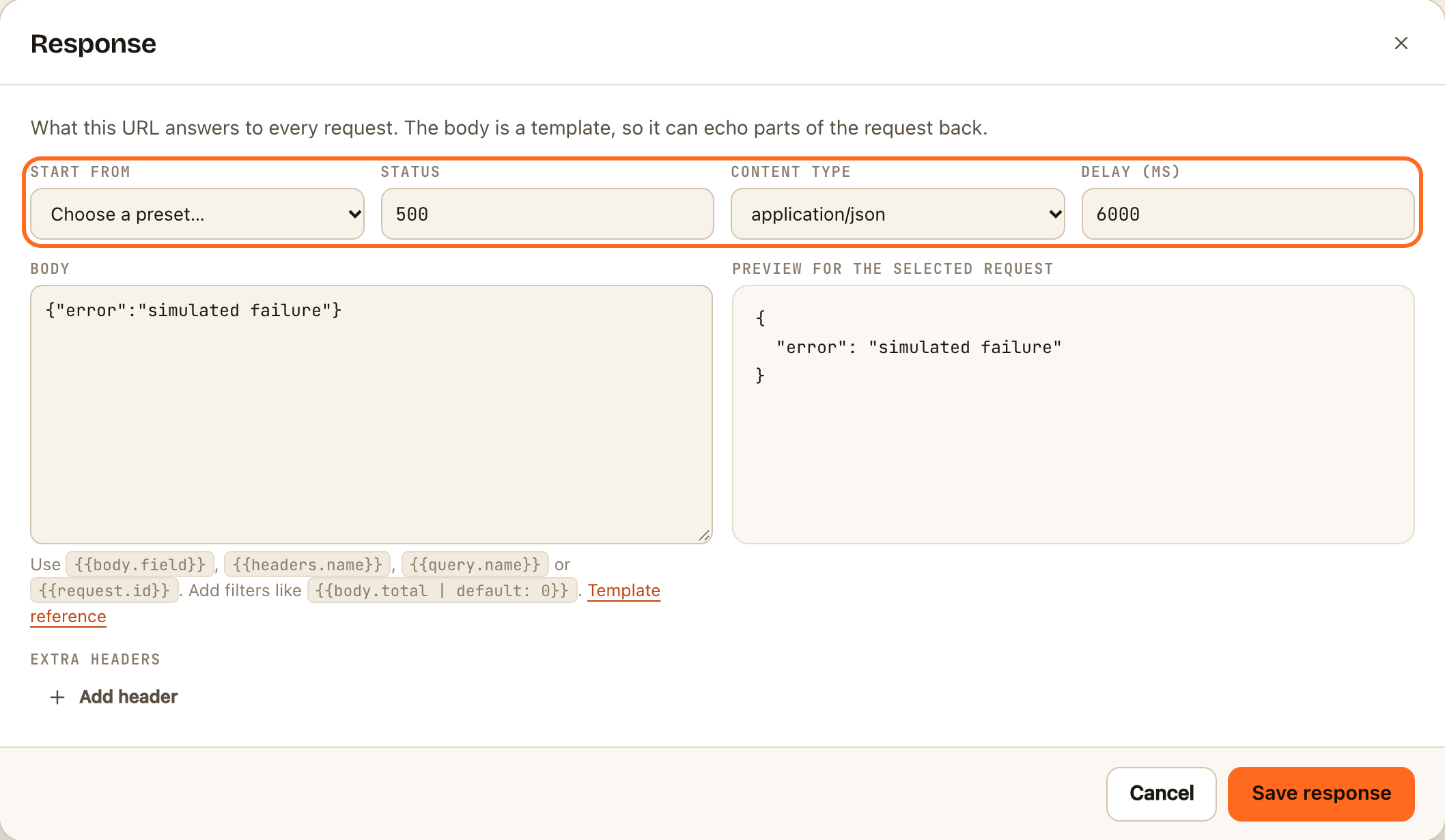
The service gives up waiting and treats the delivery as failed, even though the request was recorded. That's exactly what happens when your real handler does slow work before answering, and it's why handlers should answer first and do the work afterwards.
Put things back
When you've seen enough, open Response, choose Acknowledge (default) under Start from, set Delay (ms) to 0 and click Save response. Retries that are still scheduled will then succeed and stop.
What to look for
| Question | Where to look |
|---|---|
| How soon is the first retry, and how far apart are the rest? | The times in the request list |
| Is it the same event each time? | The event ID in the body, or a delivery ID header |
| Does the service mark the attempt number? | Headers on each retry |
| What happens after the last retry? | The service's own dashboard: some disable the webhook |